

< View All Healthcare Value Hub Articles
Washington Survey Respondents Worry about High Drug Costs; Express Bipartisan Support for Policy Solutions
Related Files
 Washington 2025 Prescription Drug Brief
Summary
A survey of more than 1,380 Washington adults conducted from September 9 to October 8, 2025, found:
- Nearly half (48%) of all survey respondents reported being either “worried” or “very worried” about
- affording the cost of prescription drugs;
- More than a quarter of respondents (26%) reported rationing medication due to cost in the last year;
- Respondents earning less than $50,000 a year (34%), those enrolled in department of veteran affairs health care (48%) and respondents with a disability or who live with a person with a disability (35%), reported rationing medication more frequently than other respondents;
- 71% of all survey respondents believe the health care system is unaffordable
- 94% of all survey respondents believe health care costs are rising; and across party lines, respondents expressed support for policy-based solutions.
Prescription drug prices in the United States are nearly 2.8 times higher than the prices in other Organization for Economic Co-operation and Development (OECD) countries, like Canada, Japan, and France.1 With nearly seven in every ten American adults (69%) prescribed at least one medication, these high costs impact the majority of the population to some degree.2
Medication Rationing
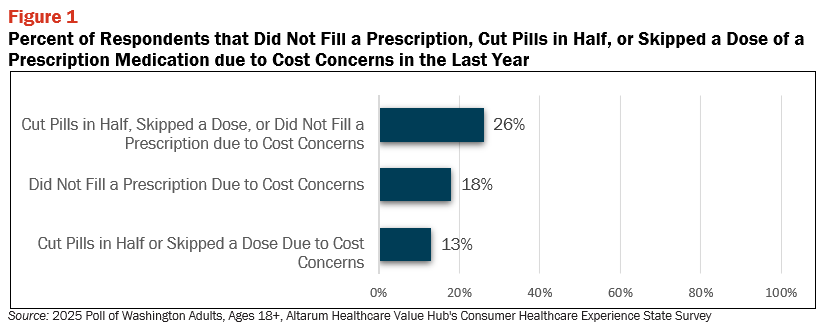
When prescription drugs are unaffordable, patients may be forced to ration the medications they have on hand by skipping doses or splitting pills in half, or they may not be able to fill their prescription at all. Individuals who ration medication often experience worse health outcomes and more frequently use health care services relative to patients who take their medication as prescribed.3 More than one in every four (26% of) respondents reported rationing medication due to cost concerns in the last year (see Figure 1).
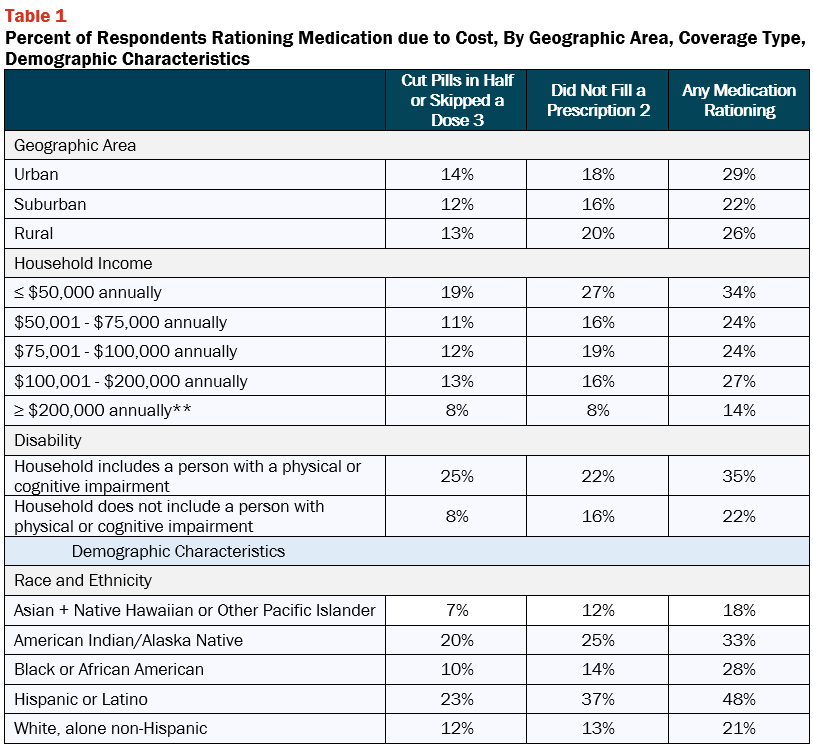
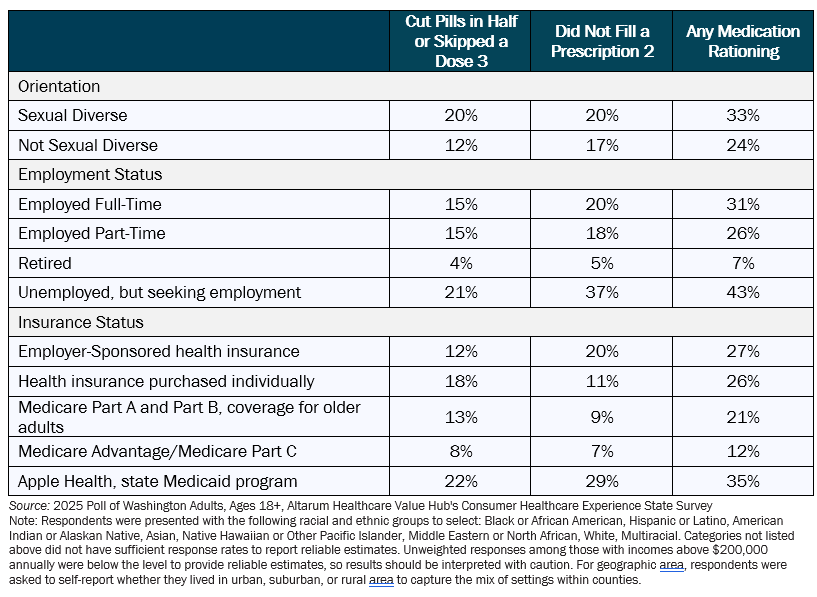
Among Washington respondents, medication rationing was most commonly reported among respondents enrolled in Department of Veterans Affairs health care (48%), followed by those without insurance (38%), and Apple Health (35%). However, certain populations were more likely to report rationing medication, such as respondents earning less than $50,000 a year and respondents with a disability or living in a household with a person with a disability (see Table 1).
Nationally, rationing behaviors occur across income and insurance status — approximately 27% of prescriptions written to insured American adults go unfilled due to insurance coverage denials. 4 While some patients are able to overcome these obstacles by using secondary insurance, paying out-of-pocket, or applying manufacturer coupons, 22% of survey respondents identified lowering what you pay out of pocket for prescription drugs, as one of their top three policy priorities for government action.
Worries about Affording the Cost of Prescription Drugs in the Future
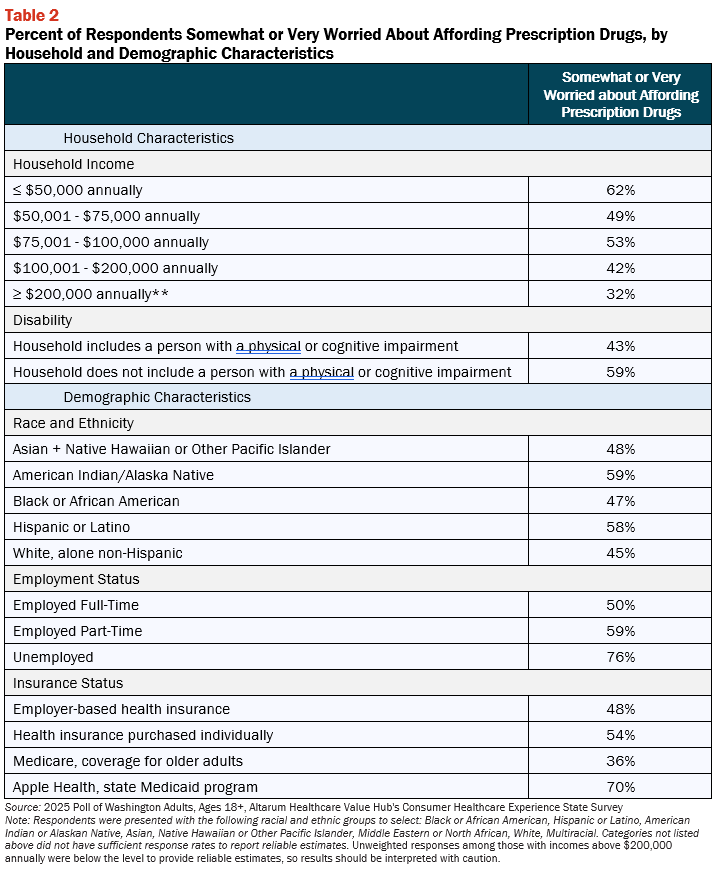
Nearly than half (51%) of survey respondents reported being somewhat or very worried about affording the cost of prescription drugs. Worry varies by income group, with respondents in households making less than $50,000 per year experiencing the most worry (see Table 2).5 However, a large percentage of households making above $75,000 per year also reported worrying about the cost of prescription drugs.
Respondent Perceptions of Health Care Systems, Policy Solutions
Washington respondents reported that they believe drug companies have a major responsibility for rising health care costs. The most frequently cited players contributing to rising health care costs were:
- 71% — Drug companies charging too much money
- 72% — Insurance companies charging too much money
- 44% — Hospitals charging too much money
When asked about their views on policy solutions to influence health care costs and efficiency, Washington respondents endorsed several strategies, including:
- 87% — Reign in how quickly prescription drug prices can increase in the private health insurance market (Medicare and Medicaid already do this);
- 88% — Limit the price of expensive prescription drugs;
- 86% — Allow your pharmacist to substitute for a lower cost prescription drug option, if available, without needing to get permission from your prescriber;
The survey also revealed that there is bipartisan support for these policy strategies as well (see Table 3).

The high burden of health care and prescription drug affordability, along with high levels of support for change, suggests that elected leaders need to make addressing this consumer burden a top priority. Annual surveys can help assess whether progress is being made. For more detailed information about health care affordability burdens facing Washington respondents, please see Healthcare Value Hub, Washington Residents Struggle to Afford High Health Care Costs; Worry About Affording Health Care in the Future; Support Government Action across Party Lines, Data Brief (November 2025).
Notes
- Mulcahy, A., Schwam, D., Lovejoy, S. (2024, February 1). International Prescription Drug Price Comparisons: Estimates Using 2022 Data. RAND Corporation. https://www.rand.org/pubs/research_reports/RRA788-3.html
- NCHS Data Query System. (2024). Prescription Medication Use Among Adults [Internet]. Hyattsville (MD): National Center for Health Statistics. https://www.cdc.gov/nchs/dqs
- Nekui, F., Galbraith, A. A., Briesacher, B. A., Zhang, F., Soumerai, S. B., Ross-Degnan, D., Gurwitz, J. H., & Madden, J. M. (2021). Cost-related Medication Nonadherence and Its Risk Factors Among Medicare Beneficiaries. Medical care, 59(1), 13–21. https://doi.org/10.1097/MLR.0000000000001458
- Understanding the Use of Medicines in the U.S. 2025: Evolving Standards of Care, Patient Access, and Spending. (2025, April). IQVIA Institute for Human Data Science. https://www.iqvia.com/-/media/iqvia/pdfs/institute-reports/understanding-the-use-of-medicines-in-the-us-2025/iqvia-institute-iqi-us-use-of-medicines-04-25-forweb.pdf
- Median household income in Washington was $99,389 (2018-2022). (U.S. Census, Quick Facts. Retrieved from: U.S. Census Bureau QuickFacts: Washington)
Methodology
Altarum’s Consumer Healthcare Experience State Survey (CHESS) is designed to elicit respondents’ views on a wide range of health system issues, including confidence using the health system, financial burden and possible policy solutions. This survey, conducted from September 9 to October 8, 2025, used a web panel from Dynata with a demographically balanced sample of approximately 1,700 respondents who live in Washington. Information about Dynata’s recruitment and compensation methods can be found here. The survey was conducted in English or Spanish and restricted to adults ages 18 and older. Respondents who finished the survey in less than half the median time were excluded from the final sample, leaving 1,383 cases for analysis. After those exclusions, the demographic composition of respondents was as follows, although not all demographic information has complete response rates:
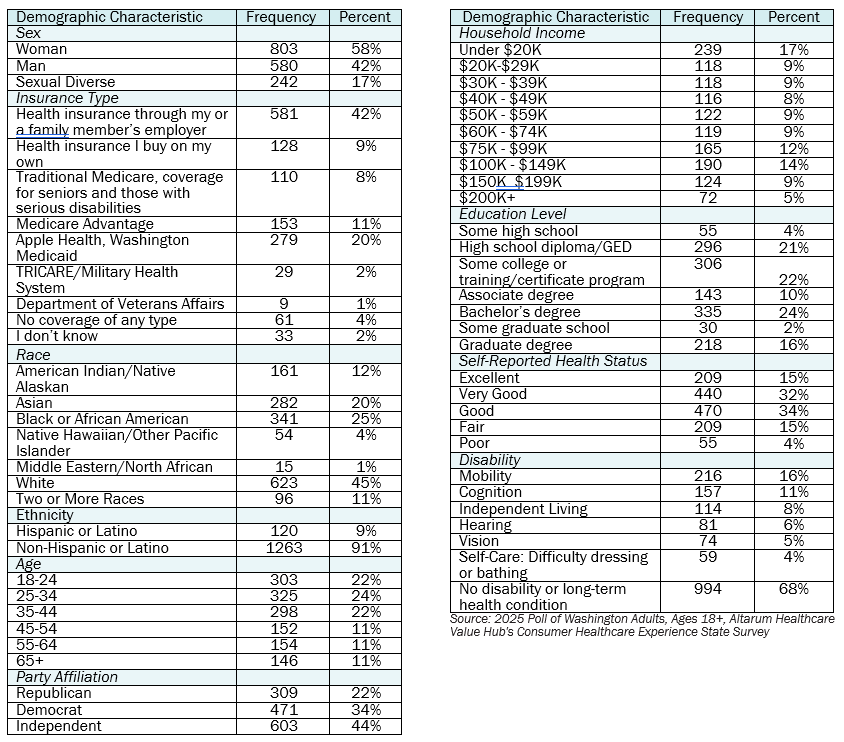
Percentages in the body of the brief are based on weighted values, while the data presented in the demographic table is unweighted. An explanation of weighted versus unweighted variables is available here. Altarum does not conduct statistical calculations on the significance of differences between groups in findings. Therefore, determinations that one group experienced a significantly different affordability burden than another should not be inferred. Rather, comparisons are for conversational purposes. The groups selected for this brief were selected by advocate partners in each state based on organizational/advocacy priorities. We do not report any estimates under N=100 and a co-efficient of variance more than 0.30.
Altarum in Action
Rhode Island Office of the Health Insurance Commissioner cites CHESS survey in letter to State House Committee on Health and Human Services about HB072 related to reimbursement rates and repealing affordability standards. Read more
Washington State Senator Patty Murray’s office cites the WA CHESS survey in press release about Senate Health, Education, Labor and Pensions (HELP) Committee hearing where Senator Murray questioned CEOs of major pharmaceutical companies about the high prices charged to Americans for their prescription drugs. Read more
Read More Altarum in Action Resources