

< View All Healthcare Value Hub Articles
Washington Survey Respondents Worry about High Hospital Costs; Face Challenges Understanding Quality and Cost of Care
Related Files
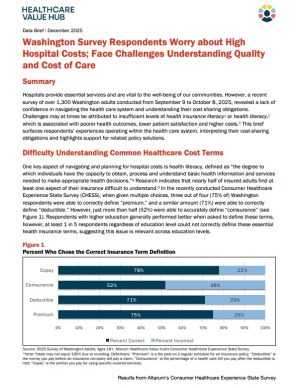
 Washington 2025 CHESS Health Literacy
Summary
Hospitals provide essential services and are vital to the well-being of our communities. However, a recent survey of over 1,300 Washington adults conducted from September 9 to October 8, 2025, revealed a lack of confidence in navigating the health care system and understanding their cost sharing obligations. Challenges may at times be attributed to insufficient levels of health insurance literacy[i] or health literacy,[ii] which is associated with poorer health outcomes, lower patient satisfaction and higher costs.[iii] This brief surfaces respondents’ experiences operating within the health care system, interpreting their cost-sharing obligations and highlights support for related policy solutions.
Difficulty Understanding Common Healthcare Cost Terms
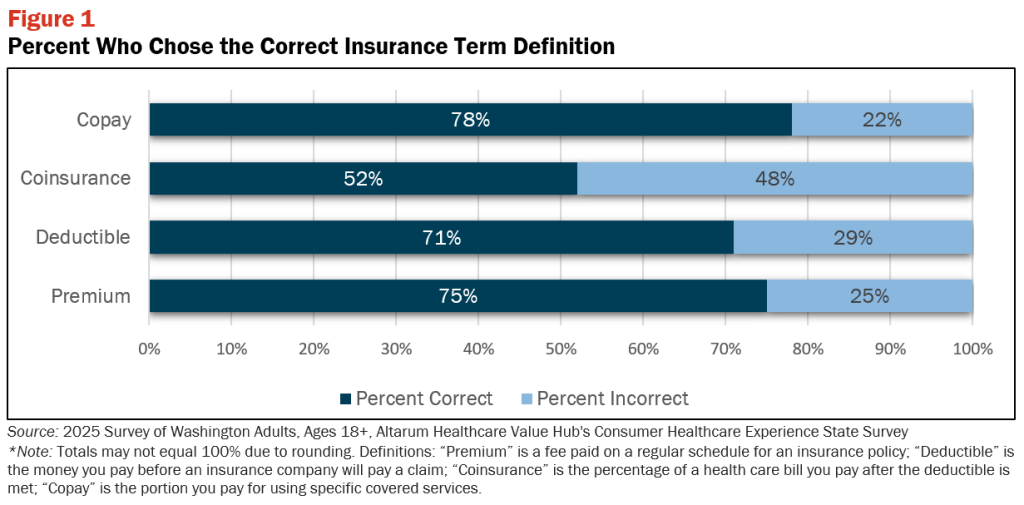
One key aspect of navigating and planning for hospital costs is health literacy, defined as “the degree to which individuals have the capacity to obtain, process and understand basic health information and services needed to make appropriate health decisions.”[iv] Research indicates that nearly half of insured adults find at least one aspect of their insurance difficult to understand.[v] In the recently conducted Consumer Healthcare Experience State Survey (CHESS), when given multiple choices, three out of four (75% of) Washington respondents were able to correctly define “premium,” and a similar amount (71%) were able to correctly define “deductible.” However, just more than half (52%) were able to accurately define “coinsurance”(see Figure 1). Respondents with higher education generally performed better when asked to define these terms, however, at least 1 in 5 respondents regardless of education level could not correctly define these essential health insurance terms, suggesting this issue is relevant across education levels.
Confidence Seeking Hospital Care, Quality, Billing Information
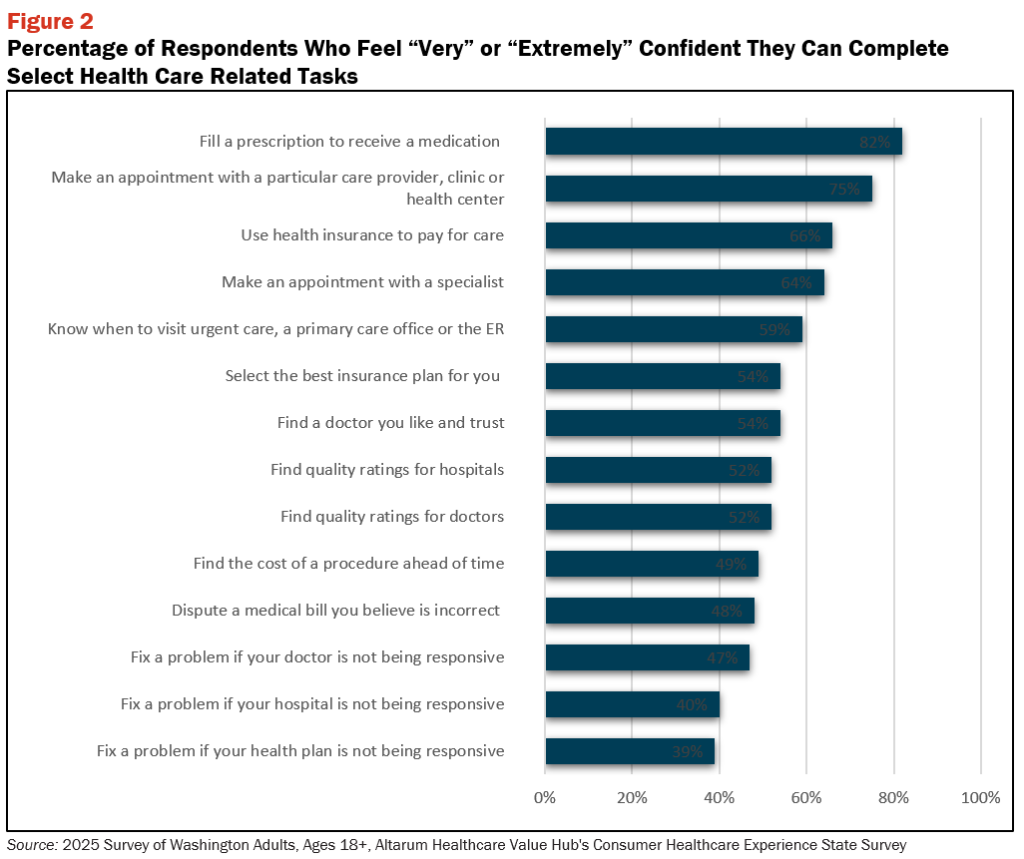
Limited knowledge of, or ability to find, health care quality or costs can also hinder consumers’ ability to budget for and navigate care, which can be especially detrimental to the under- and uninsured.[vi] Washington respondents are fairly confident in their ability to recognize when to seek emergency care, follow directions provided by their doctor, and their ability to fill a prescription. Fifty-nine percent (59%) of respondents are very or extremely confident that they know when to visit the emergency department as opposed to an urgent care center or a primary care provider (see Figure 2).
However, respondents are less confident in their ability to find hospital costs and quality information before a service. They are also less confident in their ability to resolve concerns related to financial obligations, such as disputing a medical bill. Out of all respondents:
- 51% of respondents reported they were not confident in their ability to determine the cost of a medical procedure in advance;
- 48% were confident they could dispute a bill they believed was incorrect;
- 39% were confident they could resolve an issue if their health plan was not being responsive;
- 48% are not confident in their ability to find quality ratings for doctors; and
- 48% are not confident in their ability to find quality ratings for hospitals.
Washington respondents reported a variety of strengths and challenges in navigating health insurance costs and care costs. Understanding of health insurance cost-sharing terms was mixed—while similar shares understood the terms copay, deductible, and premium, roughly one in four respondents did not correctly identify these essential terms, and even fewer correctly identified coinsurance. In addition, many respondents were not confident in their ability to find the cost of procedures ahead of time, dispute medical bills, and fix issues if their insurance or provider is not being responsive. These gaps in understanding can create confusion about cost-sharing obligations for patients and potentially result in unexpected medical bills that patients may have difficulty navigating. Policymakers can take patient health literacy and health systems navigation into account when designing and regulating health insurance products and when managing health care price transparency initiatives and patient advocacy/education programs.
[i] A person’s ability to seek, obtain, and understand health insurance plans, and once enrolled, use their insurance to seek appropriate health care services.
[ii] A person’s ability to obtain, process, and understand basic health information and services needed to manage one’s health and make appropriate health decisions.
[iii] Shahid, R., Shoker, M., Chu, L.M. et al. Impact of low health literacy on patients’ health outcomes: a multicenter cohort study. BMC Health Serv Res 22, 1148 (2022). https://doi.org/10.1186/s12913-022-08527-9
[iv] Coughlin SS, Vernon M, Hatzigeorgiou C, George V. Health Literacy, Social Determinants of Health, and Disease Prevention and Control. J Environ Health Sci. 2020;6(1):3061. Epub 2020 Dec 16. PMID: 33604453; PMCID: PMC7889072.
[v] Shahid, R., Shoker, M., Chu, L.M. et al. Impact of low health literacy on patients’ health outcomes: a multicenter cohort study. BMC Health Serv Res 22, 1148 (2022). https://doi.org/10.1186/s12913-022-08527-9
[vi] Shahid, R., Shoker, M., Chu, L.M. et al. Impact of low health literacy on patients’ health outcomes: a multicenter cohort study. BMC Health Serv Res 22, 1148 (2022). https://doi.org/10.1186/s12913-022-08527-9
Methodology
Altarum’s Consumer Healthcare Experience State Survey (CHESS) is designed to elicit respondents’ views on a wide range of health system issues, including confidence using the health system, financial burden and possible policy solutions. This survey, conducted from September 9 to October 8, 2025, used a web panel from Dynata with a demographically balanced sample of approximately 1,700 respondents who live in Washington. Information about Dynata’s recruitment and compensation methods can be found here. The survey was conducted in English or Spanish and restricted to adults ages 18 and older. Respondents who finished the survey in less than half the median time were excluded from the final sample, leaving 1,383 cases for analysis. After those exclusions, the demographic composition of respondents was as follows, although not all demographic information has complete response rates:
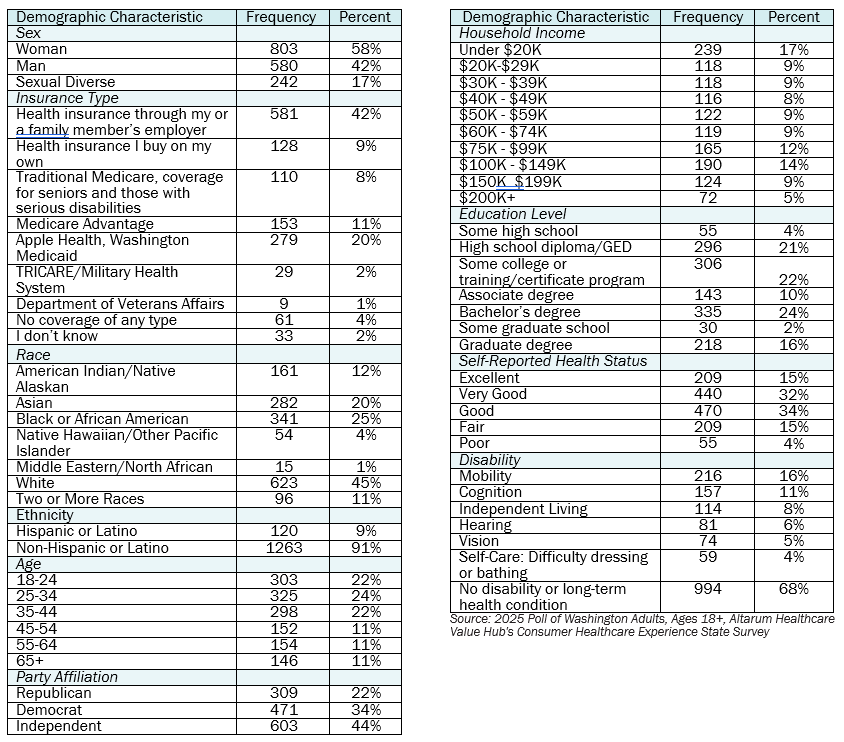
Percentages in the body of the brief are based on weighted values, while the data presented in the demographic table is unweighted. An explanation of weighted versus unweighted variables is available here. Altarum does not conduct statistical calculations on the significance of differences between groups in findings. Therefore, determinations that one group experienced a significantly different affordability burden than another should not be inferred. Rather, comparisons are for conversational purposes. The groups selected for this brief were selected by advocate partners in each state based on organizational/advocacy priorities. We do not report any estimates under N=100 and a co-efficient of variance more than 0.30.
Altarum in Action
Rhode Island Office of the Health Insurance Commissioner cites CHESS survey in letter to State House Committee on Health and Human Services about HB072 related to reimbursement rates and repealing affordability standards. Read more
Washington State Senator Patty Murray’s office cites the WA CHESS survey in press release about Senate Health, Education, Labor and Pensions (HELP) Committee hearing where Senator Murray questioned CEOs of major pharmaceutical companies about the high prices charged to Americans for their prescription drugs. Read more
Read More Altarum in Action Resources