

< View All Healthcare Value Hub Articles
Georgia Survey Respondents Worry about Hospital Costs, Face Challenges Understanding Cost and Quality Information, and Support Government Action
Download Report
 Georgia Hospital Cost and Quality Brief
Executive Summary
Background
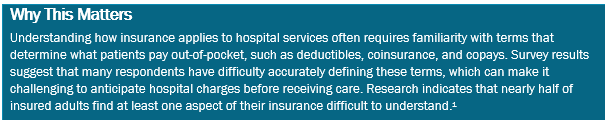
Hospitals provide essential care, but the cost of hospital services can be difficult for consumers to anticipate and afford. Findings from Altarum’s Consumer Healthcare Experience State Survey (CHESS) show widespread concern about hospital costs and gaps in consumers’ ability to find and interpret information about hospital prices, billing and quality.
This brief focuses on hospital affordability, access to cost and quality information, and support for related policy solutions. Detailed information on survey methods and respondent characteristics is available in the Appendix.
Worry about Affording Hospital Services
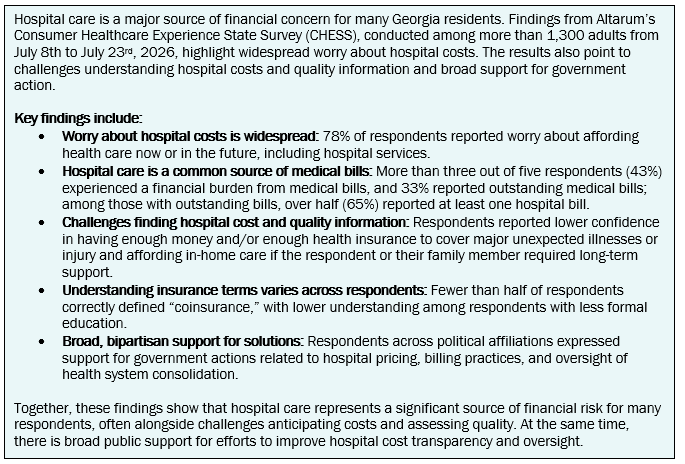
Seventy-eight percent (78%) of Georgia respondents reported being worried about affording health care, both now and in the future, including affording services commonly provided in hospitals. Respondents frequently reported worry related to services and situations that may involve high out‑of‑pocket costs, including affording nursing home care or long-term support services (61%), affording medical costs in the event of a serious illness or accident (60%), paying for medical costs when elderly (59%), and having coverage for services denied by their insurance (52%).
These concerns are reflected in respondents’ experiences after receiving care. More than two in five of respondents (43%) reported experiencing a financial burden due to medical bills and 33% of respondents reported having outstanding medical bills. Among the respondents who reported having outstanding medical bills, over half (65%) said at least one of those bills came from a hospital.
Together, these findings show that hospital services are a major source of financial worry and medical bills for many respondents. Challenges affording care and anticipating hospital costs contribute to this concern, especially when information about prices, billing, and quality is difficult to find.
Challenges Finding Hospital Cost and Quality Information
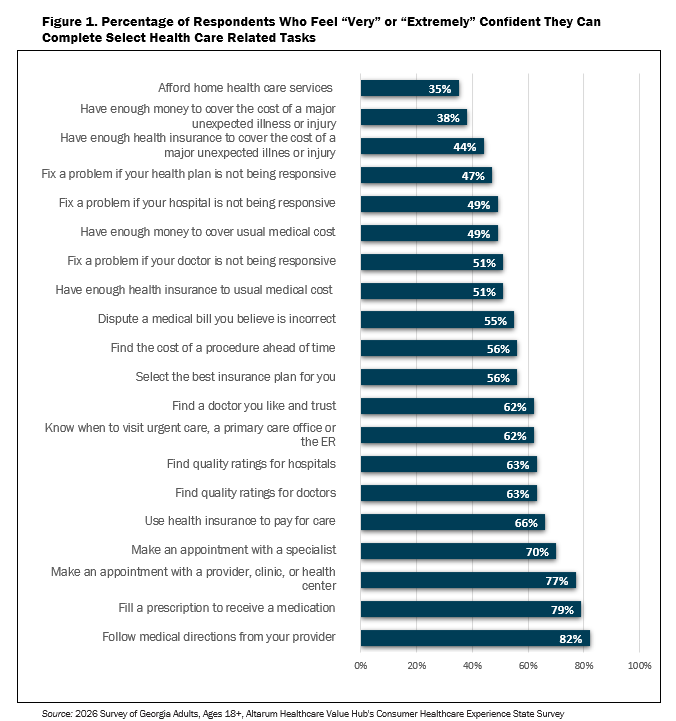
Survey results indicate that hospital care presents distinct challenges related to understanding costs, billing, and quality information before services are provided. While many respondents report confidence navigating routine health care decisions, confidence is lower for tasks that involve anticipating or managing hospital costs and quality information.
Figure 1 illustrates this contrast across common health care–related tasks. Respondents were more likely to report high confidence for activities such as following instructions from a provider (82%) or filling a prescription to receive a medication at a pharmacy (79%). In contrast, fewer respondents reported high confidence in tasks that are especially relevant to hospital care, including locating quality ratings for hospitals (63%), finding the cost of a procedure in advance (56%), and disputing a medical bill (55%).

Understanding Insurance Terms
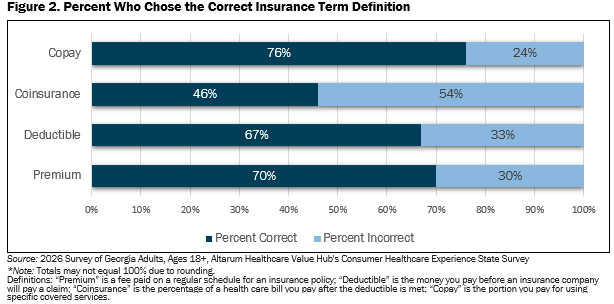
Figure 2 shows that while most respondents were able to correctly define “premium,” and “deductible,” fewer than half (46%) were able to accurately define “coinsurance,” a key component of hospital cost‑sharing after a deductible is met. Misunderstanding coinsurance can be particularly consequential for hospital services, where charges are often higher and cost‑sharing amounts are less predictable.
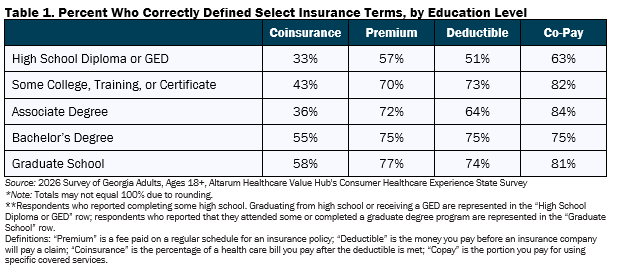
Understanding of insurance terms varied by educational attainment (Table 1). Respondents with lower levels of education were less likely to correctly define key cost‑sharing terms compared to those with a bachelor’s or graduate degree, which may make it harder for some patients to anticipate hospital costs and understand medical bills.
Perceptions of Who Drives High Costs
Survey respondents identified several actors as contributing to high health care costs. Drug companies were most frequently cited (70%), followed by health insurance (69%), and hospitals (55%). Nearly half of Georgia respondents (47%) also identified the state government as contributors to high health care costs, placing hospitals among the institutions commonly associated with rising health care expenses.
Support for Solutions to Address Hospital Costs and Transparency
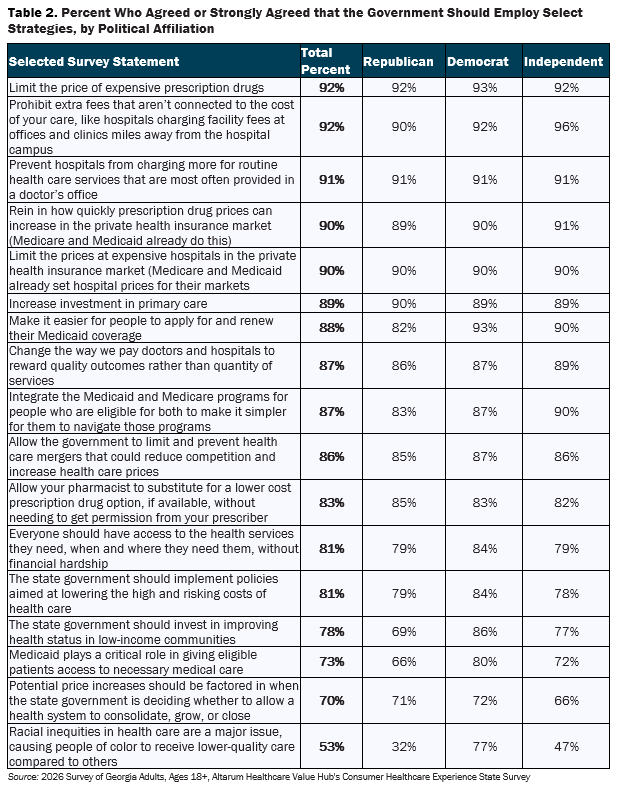
Survey respondents expressed broad support for government actions aimed at addressing health care affordability, including strategies that relate specifically to hospital costs and transparency. Across political affiliations, respondents reported that it is important for the state to play a role in protecting consumers from high and unexpected medical costs and in improving access to information needed to navigate care (Table 2).
Georgia respondents supported a range of policy approaches relevant to hospital care, including limiting excessive hospital prices, addressing billing practices that increase costs without improving care, and strengthening oversight of health system consolidation that may contribute to higher prices. Support for these strategies was observed among Republicans, Democrats, and Independents, suggesting shared concern about the impact of hospital costs on patients and families.
Together, these findings indicate that concerns about hospital affordability and transparency are accompanied by broad public support for government efforts to improve how hospital prices are set, communicated, and regulated.
Conclusion
Findings from the State Consumer Healthcare Experience State Survey show that hospital care is a significant source of financial concern for many respondents. Widespread worry about affording hospital services is accompanied by challenges finding and understanding hospital cost, billing, and quality information before care is received.
These findings show how difficulty anticipating hospital costs and assessing quality may increase the risk of unexpected medical bills and financial strain. At the same time, respondents across political affiliations express support for government efforts to improve hospital cost transparency and accountability, underscoring shared concern about the impact of hospital costs on patients and families.
Notes
[1] Pollitz, K., Pestaina, K., Montero, A., Lopes, L., Valdes, I., Kirzinger, A., Brodie, M., KFF Survey of Consumer Experiences with Health Insurance, (KFF, June 15, 2023) https://www.kff.org/report-section/kff-survey-of-consumer-experiences-with-health-insurance-methodology/ (Accessed December 5, 2024).

Appendix. Methodology and Population
Altarum’s Consumer Healthcare Experience State Survey (CHESS) is designed to elicit respondents’ views on a wide range of health system issues, including confidence using the health system, financial burden and possible policy solutions. This survey, conducted from July 8th to July 23rd, 2026, used a web panel from Dynata with a demographically balanced sample of nearly 1,400 respondents who live in Georgia. Information about Dynata’s recruitment and compensation methods can be found here. The survey was conducted in English or Spanish and restricted to adults ages 18 and older. Respondents who finished the survey in less than half the median time were excluded from the final sample, leaving 1,379 cases for analysis. After those exclusions, the demographic composition of respondents was as follows, although not all demographic information has complete response rates:
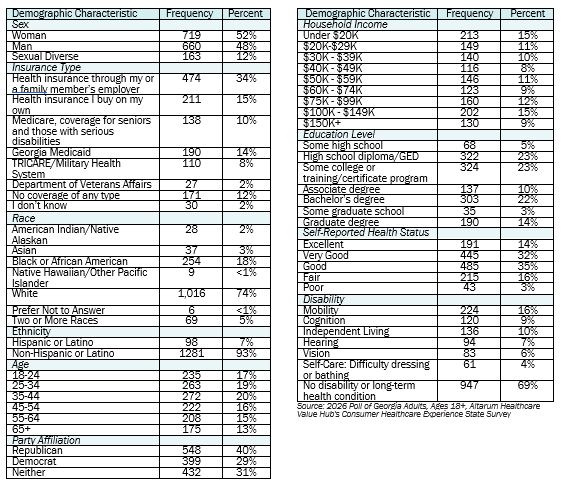
Percentages in the body of the brief are based on weighted values, while the data presented in the demographic table is unweighted. An explanation of weighted versus unweighted variables is available here. Altarum does not conduct statistical calculations on the significance of differences between groups in findings. Therefore, determinations that one group experienced a significantly different affordability burden than another should not be inferred. Rather, comparisons are for conversational purposes. The groups selected for this brief were selected by advocate partners in each state based on organizational/advocacy priorities. We do not report any estimates under N=100 and a co-efficient of variance more than 0.30.
Altarum in Action
Rhode Island Office of the Health Insurance Commissioner cites CHESS survey in letter to State House Committee on Health and Human Services about HB072 related to reimbursement rates and repealing affordability standards. Read more
Washington State Senator Patty Murray’s office cites the WA CHESS survey in press release about Senate Health, Education, Labor and Pensions (HELP) Committee hearing where Senator Murray questioned CEOs of major pharmaceutical companies about the high prices charged to Americans for their prescription drugs. Read more
Read More Altarum in Action Resources