

< View All Healthcare Value Hub Articles
Pennsylvania Survey Respondents Worry about Hospital Costs, Face Challenges Understanding Cost and Quality Information, and Support Government Action
Download Files
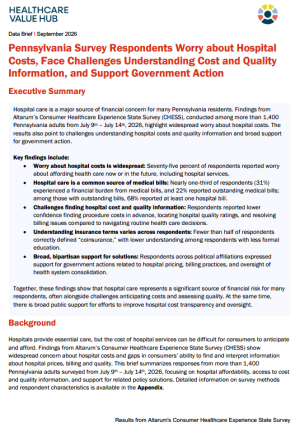
 Pennsylvania Hospital Cost 2026
Background
Hospitals provide essential care, but the cost of hospital services can be difficult for consumers to anticipate and afford. Findings from Altarum’s Consumer Healthcare Experience State Survey (CHESS) show widespread concern about hospital costs and gaps in consumers’ ability to find and interpret information about hospital prices, billing and quality. This brief summarizes responses from more than 1,400 Pennsylvania adults surveyed from July 9th – July 14th, 2026, focusing on hospital affordability, access to cost and quality information, and support for related policy solutions. Detailed information on survey methods and respondent characteristics is available in the Appendix.
Worry about Affording Hospital Services
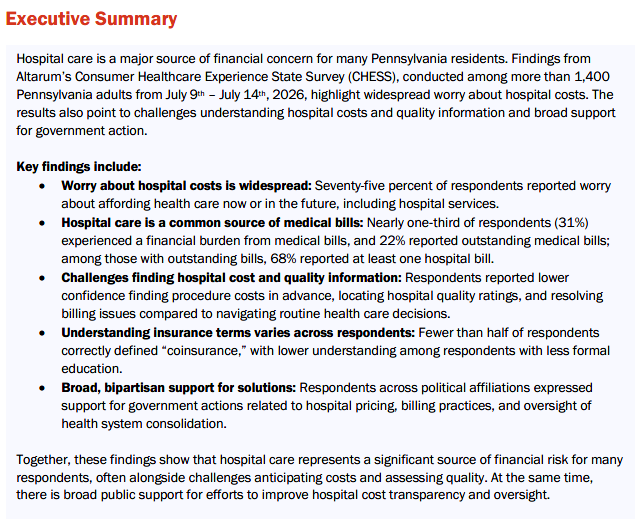
Seventy-five percent of Pennsylvania respondents reported being worried about affording health care, both now and in the future, including affording services commonly provided in hospitals. Respondents frequently reported worry related to hospital-associated services and situations that may involve high out‑of‑pocket costs, including medical care for a serious illness or accident (52%), maternity or reproductive care (25%), and ambulance services in an emergency (45%).
These concerns are reflected in respondents’ experiences after receiving care. Nearly one-third of respondents (31%) reported experiencing a financial burden due to medical bills and 22% of respondents reported having outstanding medical bills. Among the respondents who reported having outstanding medical bills, greater than two in every three respondents (68%) reported at least one of those bills came from a hospital.
Together, these findings show that hospital services are a major source of financial worry and medical bills for many respondents. Challenges affording care and anticipating hospital costs contribute to this concern, especially when information about prices, billing, and quality is difficult to find.
Challenges Finding Hospital Cost and Quality Information
Survey results indicate that hospital care presents distinct challenges related to understanding costs, billing, and quality information before services are provided. While many respondents’ report confidence navigating routine health care decisions, confidence is lower for tasks that involve anticipating or managing hospital costs and quality information.
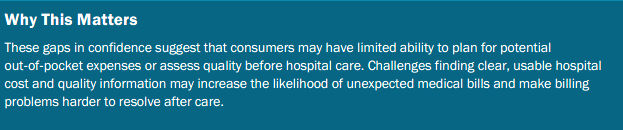
Figure 1 illustrates this contrast across common health care–related tasks. Respondents were more likely to report high confidence in their ability to perform activities such as filling a prescription (82%) or following instructions from a provider (84%). In contrast, fewer respondents reported high confidence in tasks that are especially relevant to hospital care, including finding the cost of a procedure in advance (50%), locating quality ratings for hospitals (59%), and disputing a medical bill (53%).
Understanding Insurance Terms
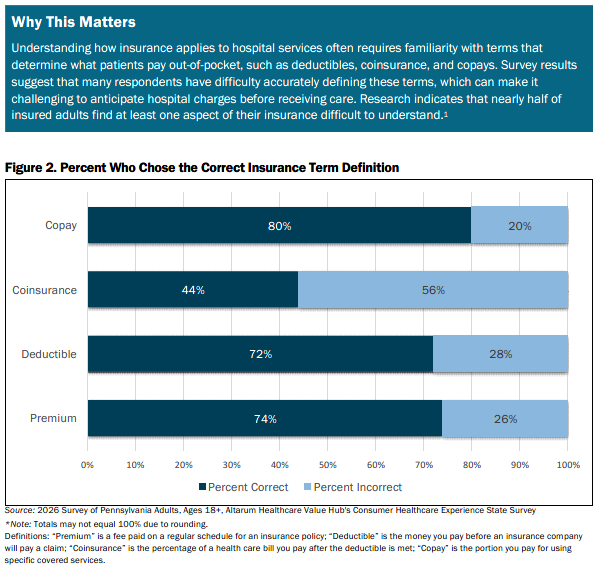
Figure 2 shows that while most respondents were able to correctly define “premium,” and “deductible,” fewer than half (44%) were able to accurately define “coinsurance”, a key component of hospital cost‑sharing after a deductible is met. Misunderstanding coinsurance can be particularly consequential for hospital services, where charges are often higher and cost‑sharing amounts are less predictable.
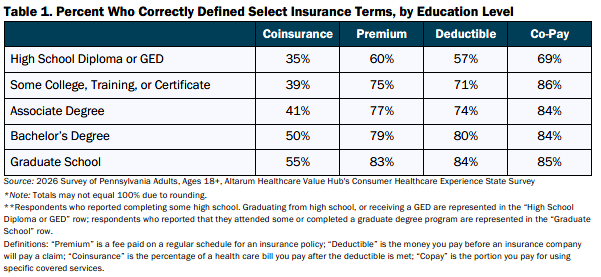
Understanding of insurance terms varied by educational attainment (Table 1). Respondents with lower levels of education were less likely to correctly define key cost‑sharing terms compared to those with a bachelor’s or graduate degree, which may make it harder for some patients to anticipate hospital costs and understand medical bills.
Perceptions of Who Drives High Costs
Survey respondents identified several actors as contributing to high health care costs. Drug manufacturers were most frequently cited (75%), followed by health insurance companies (72%). More than half of Pennsylvania respondents (56%) also identified hospitals as contributors to high health care costs, placing hospitals among the institutions commonly associated with rising health care expenses.
Support for Solutions to Address Hospital Costs and Transparency
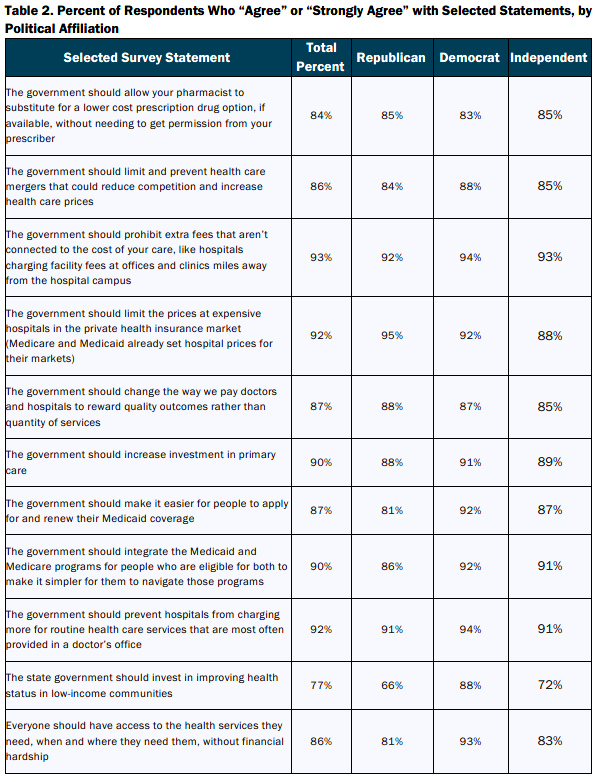
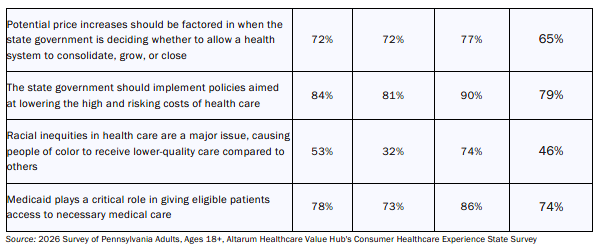
Survey respondents expressed broad support for government actions aimed at addressing health care affordability, including strategies that relate specifically to hospital costs and transparency. Across political affiliations, respondents reported that it is important for the state to play a role in protecting consumers from high and unexpected medical costs and in improving access to information needed to navigate care (Table 2).
Pennsylvania respondents supported a range of policy approaches relevant to hospital care, including limiting excessive hospital prices, addressing billing practices that increase costs without improving care, and strengthening oversight of health system consolidation that may contribute to higher prices. Support for these strategies was observed among Republicans, Democrats, and Independents, suggesting shared concern about the impact of hospital costs on patients and families.
Together, these findings indicate that concerns about hospital affordability and transparency are accompanied by broad public support for government efforts to improve how hospital prices are set, communicated, and regulated.
Conclusion
Findings from the Pennsylvania Consumer Healthcare Experience State Survey show that hospital care is a significant source of financial concern for many respondents. Widespread worry about affording hospital services is accompanied by challenges finding and understanding hospital cost, billing, and quality information before care is received.
These findings show how difficulty anticipating hospital costs and assessing quality may increase the risk of unexpected medical bills and financial strain. At the same time, respondents across political affiliations express support for government efforts to improve hospital cost transparency and accountability, underscoring shared concern about the impact of hospital costs on patients and families.
Altarum in Action
Rhode Island Office of the Health Insurance Commissioner cites CHESS survey in letter to State House Committee on Health and Human Services about HB072 related to reimbursement rates and repealing affordability standards. Read more
Washington State Senator Patty Murray’s office cites the WA CHESS survey in press release about Senate Health, Education, Labor and Pensions (HELP) Committee hearing where Senator Murray questioned CEOs of major pharmaceutical companies about the high prices charged to Americans for their prescription drugs. Read more
Read More Altarum in Action Resources